

Student Spiritual Biography Series
Installment 4 - Douglas Jasper Doise
I was born in 1994 in the South of Louisiana, central Acadiana. My roots are firmly in the ground there where generations of my grandparents' bones rest, once dwelt by the Atakapa-Ishak, the Houma, the Chitimacha, the Choctaw, and more, but now Cajun Country. Cajuns themselves are a twice-displaced people, first across the Atlantic and then across the continent. They carried a deep Roman Catholic heritage with them, which my parents grew up in but both separated from (as well as each other) in that third and final displacement that left me in a gap, an empty space between the old and a potential new.
I was baptised into the Roman church but educated in modern Episcopalian schools, which retained a liturgy I appreciated, but in my experience little to nothing in the way of direct spiritual formation or religious education. At home I found myself left with little more of my religious inheritance than Evangelical cultural trinkets like the Veggie Tales cartoon for formation - which ultimately I remember with fondness, despite their insufficiency. What I lacked really was anyone in my life who could show me what a conscious discipline of Christian life looked like, lived out, day by day.
In a spirit of acceptance and hopefully not vanity, I interpret my condition of lack as representing, or at least resonating with a spiritual condition of our cultural age; at least for my own biography, it is an emptiness I am invited to inhabit, that invites my work to build something of my own there, a co-creative relationship with Creation and Creator.
The lack of direct guidance did give me room to play creatively in religious forms, in the privacy of a space where no one who knew better intruded. I sometimes created my own ritual as needed to fill apparent empty spaces. My impulses repeatedly led me to break from established form, against social pressure, out of an urge to adhere to an inwardly felt rightness. I felt more than I knew, but I had no guidance in translating that feeling into articulation. When my intellect and criticality came to bear upon it, there was no structure to bear the gravitational force.
As a teenager I encountered the Bible for the first time in a systematic way, in a class where we read through the Pentateuch as literature. The thorough strangeness of those Books met my lack of grounding and I fell into the whole existential questioning of my adolescence. I relied on what I did have at hand, a reasonably thorough scientistic-materialist education, and at the end of my wrestling I found that my questions about God were (all too easily) answered by a postmodern, materialist metaphysics. I named myself agnostic, at which my Dad was deeply offended - quite to my surprise, never having really seen his faith expressed in more than mostly-weekly church attendance. I supposed then that he was simply mad that I wasn't successfully brainwashed; now I can see a far more layered sadness and frustration at this way, among others, that I was actively distancing myself from him.
Soon after, I chose to leave off moving back and forth between my parents' houses, staying with my Mom. She and I soon left off church as well, when I argued the simple logic that if a personal relationship with God was what mattered, I could still consider that privately, without need for the social form. Surprising me, she offered no counterargument. I've since come to understand that she must have basically agreed, having gotten no real support from her religious community in her troubled youth. I had some inchoate intention to spend time on Sunday mornings considering my questions of faith; finding myself alone, I had no one to consider them with.
At my school, each member of the senior class was expected to give a presentation at morning chapel on a yearly theme: our class's was on our spiritual journeys. While comfortable with public speaking, I wrestled with how openly I desired to present my disbelief. I decided to be thoroughly honest and received a standing ovation instead of a fight. Again the confrontation I loosely expected, this time with some member of faculty or our pastor, simply failed to appear. My father had thrown anger at me that I could not meet; I only knew how to keep asking for a fight while starved for a conversation. I had learned to protect myself rather than offer curiosity.
From high school I followed the path of least resistance to a scholarship at the state university, entering into Computer Science, intending to program video games. I was confronted in turns by the stark personal indifference of the academic structure, my lack of any real community or emotionally supportive relationships, and the desolation of my potential condition in my intended career; once again I teetered on the slope of the existential abyss, the previous answers clearly insufficient.
When not distracting myself I sought answers in political-economic theory, transforming from a mostly formless reactionary into an iconoclastic anarchist. I felt my eyes opened to all suffering. Clearly, we humans, solely responsible, had constructed a hell. Tradition offered only desolation. Where would it be possible for me to apply my life's strength without my effort being drained into the continuation of all this suffering, only a scant fraction of which is my lot to experience? Having foreclosed my ability to consider the real answer to that question, I wandered the labyrinth. Occasional beams of meaning shone through the dust, leading me on while I could not recognize their source. I slowly choked in depression until I was confronted by the face of my suicide, hanging from the light fixture of the little courtyard leading to the garage.
That encounter still underlies my days. I re-chose my existence in full consciousness, a repetition of an action I suppose I made prior to this incarnation. This foundation of my experience is an every-moment choosing of life, the only answer I have to my most noteworthy prosecutor, the spirit of nihilist despair.
The rest of my story thus far is a growing by fits and starts of an ability to perceive the source of life, and working to move in the direction of that perception. I sought a living Good, a firm place at which to stand. I continued to investigate human social structures, seeking a form that provided for the growth of the individual's sense for Good. An anarchist insurrectionism gave me real clarity - it proposed that the right response to oppressive power was to simply act as best you can to live rightly, in a way that starved the existing system of your support by putting into practice a better society as an enclave within it. Yet, when I looked ahead on that path, I saw ineffectuality; the best and brightest stars in my field were guttering flames meeting hurricane-force opposition. The most successful of these by an order of magnitude, however, were those whose distinctive characteristic was indigeneity (specific inspirations were/are the EZLN and Rojava). Seeking understanding, I moved into a focus on decolonial theory.
Through working with decolonial phenomenology, I was offered a realization of how I had given away the responsibility of determining simply what was real to an authority outside my conscience: to, however fond I was of it, a materialist schooling steeped in an imperialist viewpoint. If I intended to genuinely communicate with anticolonial voices, I would have to really consider their interaction with the other-than-human and spiritual worlds in the way they communicated it, instead of forcing what I heard to fit into my own boxes. I finally learned how to be curious about the world again.
Since that point, I have gone through some major transformations in my personal circumstances - seeking community and spiritual life in communes and rebellion. While part of this journey has resulted in my joyful marriage, I've been unsatisfied with the results of my explorations into utopian forms, especially when secular. I suspect the ideal form of anarchist insurrectionism was expressed two millenia ago in the impetus that birthed Christianity, and its best principles expressed in the Great Commandments.
This path has thrown my shadow into stark relief. There remains no doubt in my conscious mind that my inner work lies in the direction of discipleship to Jesus Christ, but I run every day up against the barriers I have placed in my own way between me and that being who is my very own life. May the Lord have mercy upon me; the source of Life shine in my life, in me and through me into the beloved world.
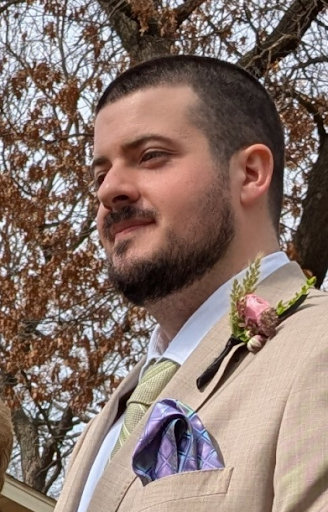
Douglas Jasper Doise, is a Knowing Christ student in the hybrid-online program. He lives in St. Paul Minnesota, USA.
This is a blog entry by The Seminary of the Christian Community in North America. These are posted weekly by the student blog team of Athena Masilungan, Nicole Reinhart, and Lincoln Earle-Centers. For more information about our seminary, see the website: www.christiancommunityseminary.ca and for more video/audio content check out the Seminary’s Patreon page: www.patreon.com/ccseminary/posts.
The views expressed in this blog entry are the views of its author, and do not necessarily represent the views of the Seminary, its directors, or the Christian Community.