
Learning to Participate
By Lisa Ni Conchuir
As a student in the “Knowing Christ” program at the North American Seminary, there is a theme of learning to participate. This has not been explicitly spoken as a theme. Our subjects at present are Anthroposophy and Christianity, Sacramental Theology, Gospel Study, Shepherding (also called Inner Life Development) Eurythmy, Speech, Art and Phenomenology. However, woven through all of this rich content and activity is the cultivation of participation. Developing a life with Christ Jesus is one of participation whether one is a seminary student, priest, congregant, or seeker who longs to know Christ Jesus in individual life.
For many years in The Christian Community in Melbourne with my daughter, I attended the family festivals, talks and Children's Service. I loved all of these gifts from the church and received them with gratitude. The words of the Children’s Service were simple to take in and contemplate, the festival stories moved my heart and the talks were engaging. From each talk I attended, I received new learning. From this learning I tried to improve my understanding and participation in life. In these activities my intentional and yet still mainly unconscious participation with Christ Jesus began.
Did you notice something missing? Hmmm … the Act of Consecration of the Human Being (as it is called in Australia). I could not, or chose not to attend the Act of Consecration of the Human Being as I had great difficulty engaging with it. Important note: Please do keep reading after the following sentence as it is a journey! I’d sit there wondering if everyone else was as bored as I was? My experience was so different from attending the Children’s Service. Maybe this was a reflection of where my soul development was at this time.
Then one day I arrived at church for a talk. As I arrived the people were coming out of the chapel as the Act of Consecration of the Human Being had just finished. It was at this moment, which I still remember vividly, that I noticed a glow about everyone coming out and I realised I was missing something. I did not understand what was happening during the service. The next time I attended, I decided to participate as much as I could. I listened as intently as possible to the words of the service. I did the three crossings* physically and visualised them inside my body, feeling the words as I said them. I chose to participate in the service and was changed, and have never found the service boring since. Instead I long to attend and participate.
Now, I would like to share with you some recent learning from the Seminary on-site week that has enriched my participation, and I hope that my sharing in turn may help enrich another’s participation.
We learned and discussed that the words in the service and the Gospel reading come from the spiritual world. We need to practice to hear them in this way. We need to take the words into our thinking and feel them. If we open these doorways to a new listening, thinking and feeling, our participation with Christ Jesus deepens, just as we hear in the service “thus Christ thinks in us.” We need to participate to help bring Christ into our thinking. In the so-called “June Course,” (the first lectures given to the individuals who came together with an interest in forming a renewal of religious life, many who later became priests), Rudolf Steiner said of the Gospel reading that “it signifies the sounding forth, the revelation of the Word within the congregation. When human beings experience the inspired Word sounding forth from out of the spiritual world.” So we are participating by actively listening and hearing that the words come forth from the spiritual world.
We can also participate when we hear the server, who is the voice of the congregation, saying “May it be revealed through you, O Christ.” This is our prompt to listen more deeply to the Gospel. May we hear it through the voice of Christ. Also at the end of the Gospel the server says “We lift up our soul to you, O Christ.” We, the congregation, are intending to become one congregational soul at this time. The word used here is singular, one soul, rather than individual souls. We participate with each other, with the priest and with Christ; we who are many become one. St Paul speaks deeply of participation in the body and blood of Christ and of the many becoming one, “The cup of blessing that we bless, is it not a participation in the blood of Christ? The bread that we break, is it not a participation in the body of Christ? Because there is one bread, we who are many are one body, for we all partake of the one bread” 1Cor 10:16-17 (ESV).
I invite you now when next you participate in the Act of Consecration of the Human Being, or are reading the Gospel at home, to strive to know and hear that the words are “sounding forth from out of the spiritual world” to yourself and to all those listening.
I would like to close by returning to the glow of those who have attended the Act of Consecration of the Human Being. Kahlil Gibran wrote in the Prophet, “Work is love made visible.” The work of our participation, not just receiving but being active inwardly, is the work that helps to make the Being of Love, Christ Jesus, visible in the everyday world through us.
*If they wish to, the congregation may make the sign of a small cross on the forehead to the words spoken by the priest “The Father God be in us,” then a cross over the chin to the words “The Son God create in us,”and then a cross over the heart to the words “The Spirit God enlighten us.” This invitation and accompanying words occurs seven times within the The Act of the Consecration of the Human Being.
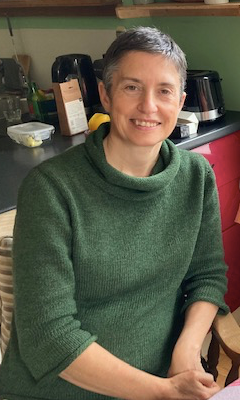
Lisa Ni Conchuir, 53, is a student in the “Knowing Christ” Hybrid program. She lives with her husband Ronan in the beautiful Yarra Valley, just outside Melbourne, Australia. Alongside the joys of Seminary study and The Christian Community, Lisa enjoys gardening -particularly berry growing, growing plants and produce for market sale, hosting Biodynamic workshops, walking in nature and in spare moments some relaxation with calligraphy or wood carving.
This is a blog entry by The Seminary of the Christian Community in North America. These are posted weekly by the student blog team of Athena Masilungan, Nicole Reinhart, and Lincoln Earle-Centers. For more information about our seminary, see the website: www.christiancommunityseminary.ca and for more video/audio content check out the Seminary’s Patreon page: www.patreon.com/ccseminary/posts.
The views expressed in this blog entry are the views of its author, and do not necessarily represent the views of the Seminary, its directors, or the Christian Community.