
A Healing Journey Through Art
By Roy Straver
“The task of art is to take hold of the shining, the radiance, the manifestation, of that which as spirit weaves and lives throughout the world. All genuine art seeks the spirit. Even when art wishes to represent the ugly, the disagreeable, it is concerned, not with the sensory-disagreeable as such, but with the spiritual which proclaims its nature in the midst of unpleasantness. If the spiritual shines through the ugly, even the ugly becomes beautiful” (Rudolf Steiner, Lecture VI of The Arts and Their Mission, given on June 9, 1923,GA 276).
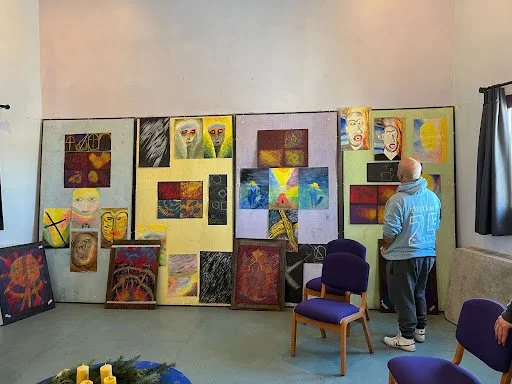
During Michaelmas Term the seminary students worked every Monday with artist and art teacher Regine Kurek on a healing journey through art. We started with a short history of art in the 19th century. During this period, artists such as Van Gogh, Delacroix, Turner, and Wagner began to make inner experiences, moods, and personalities visible. This breakthrough in the arts meant that it was no longer merely aesthetic, but became emotionally and spiritually charged. From this time on, inner life was brought outward through art.
Six artworks from 19th century masters are on the table, all upside down. Six works representing sickness and distortion of personality are appointed to us. Or rather, as we turn them over to reveal each painting, the painting chooses us.
Through connection with a specific artwork, we are confronted with a sickness, a disturbing expression of imbalance. The first step on the journey invites us to connect with the sickness. Inwardly connecting with the darkness, the Being that is sick, enlivens the call to become whole, to heal. First we fully acknowledge the sickness, and strive to take ownership of it. We resist all ideas and inner attempts to already heal, to figure out how we will make it whole, we suspend the will to change anything at all and acknowledge the sickness in order to better know what ailment is living there.
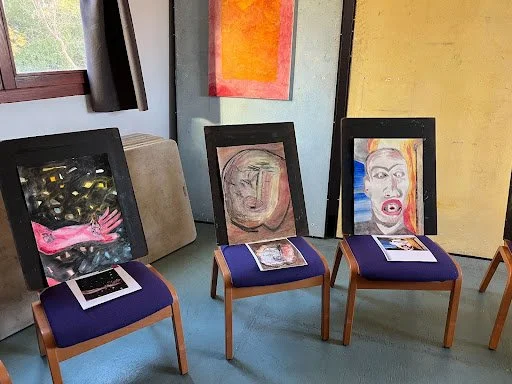
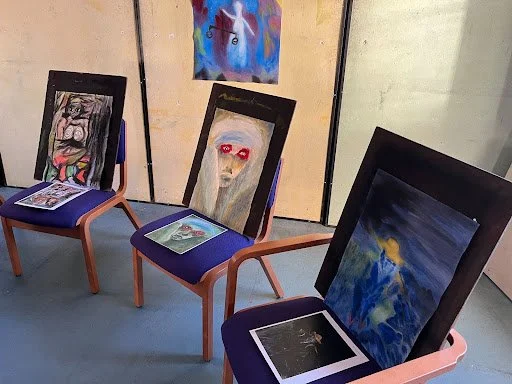
First we repaint the work, wet-on-wet, and make it our own without trying to heal it. The wet-on-wet effect already softens the first painting somewhat. We make the illness our own and live in it.
The second week, starting from where we ended, we then take a small step towards healing. When we begin to heal, the illness becomes more apparent. We suddenly become conscious of the depth of the sickness, and it becomes more expressive. While more light and colour begin to emerge, what is not whole also finds more expression. In the pain that comes when we try to take up this responsibility, a bit more black comes to the surface; what was previously a dark wound shows a bit more blood. Yet we give something that may grow. In the end, we have a little more colour, softer lines, a bit more distance.
The third week, destiny takes hold. We give up the grip of our own healing journey. In every genuine transformation there is a point where only a willingness to let go of oneself creates the conditions for becoming. Each of us takes up the work of another, guiding the process in an unforeseen direction and opening the way to transformation. Each work is broken open by an inspiration from above, and each of the works is enriched by a surprise, a new revelation of healing. Something is brought to the situation that could not have been imagined from the perspective of the one seeking healing by itself. One of us notices while walking around in the room that all of us are breathing more deeply, similar to breathing in deep sleep.
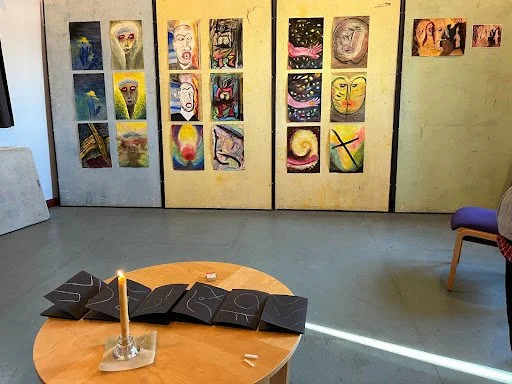
The fourth week, the process is back in our own hands. Having received a transformation, we now bring our work to a completion. We fulfill the work by integrating our own journey with what we have received.
Upon reflection, we journeyed the four steps of initiation or the four stages in the Consecration of the Human Being. In the first step, the preparation, the call comes through the Gospel. This is followed by the purification, where we offer something, where we acknowledge the resistance, corresponding to the Offering. Then, a moment of not knowing, hoping, letting go. Crossing the abyss requires a willingness to die before the third step can begin: an illumination where transformation happens, a revelation can come as a gift, an unexpected entering of the future into what is. This corresponds to the Transubstantiation. And fourth, union brings us into wholeness through the Communion, where the possibility to feel ourselves as revelation of the divine resounds.
The artistic process asks us to enter something, to seek a relationship to a being. The ugly aspects can become the larva for the beauty that may become. Such as Rudolf Steiner’s words “If the spiritual shines through the ugly, it becomes beautiful, for beauty is not the appearance but the manifestation of the spirit” (GA 276). So do we experience that our sickness, the darkness, is the substance out of which our becoming grows.
“And he who was seated on the throne said, ‘Behold, I am making all things new‘“ Rev 21:5 (ESV). The wrestling that the artist experiences when opening to what is, receiving moral essence, and weaving a creative work, can transform the stone-like resistance of what is, and by receiving future streaming, may make it into building blocks of a future world,
“For the real truth is not truth,
but the conquered error.
And true reality is not reality,
but the conquered illusion.
And true purity is not the original purity,
but the purified impurity.
And true goodness is not the original good,
but the conquered evil.
This is true for the whole world, including the gods.
For in the way in which evil is transformed,
something can develop,
that was not even originally present in the good.
Because God created the adversarial forces,
he forced himself
to reveal his deepest being in different ways
then he could have done without them.”
Friedrich Benesch
Roy Straver is a “Knowing Christ” seminary student. He was born in the Netherlands and is currently living on-site in Toronto at the seminary with his family.
This is a blog entry by The Seminary of the Christian Community in North America. These are posted weekly by the student blog team of Athena Masilungan, Nicole Reinhart, and Lincoln Earle-Centers. For more information about our seminary, see the website: www.christiancommunityseminary.ca and for more video/audio content check out the Seminary’s Patreon page: www.patreon.com/ccseminary/posts.
The views expressed in this blog entry are the views of its author, and do not necessarily represent the views of the Seminary, its directors, or the Christian Community.