

The Substance of Compassion in Human Relationships: Reflections on the Fifth Beatitude - By Emma van der Steen
Every morning I walk with my daughters in the garden of the seminary and church to greet all the flowers. Spring has finally arrived in Canada, but Canadian spring is different from European spring. One night, there was thunder and hail. The next day there was sunshine. And as we walked that morning in the garden, we were marveling how the fragile flowers could withstand the turbulent weather of the Canadian spring months. When we looked closer however, we saw that many a ring of thick strong leaves surround the fragile face of the flower. This is called the flower calyx, it is holding and supporting the beautiful fragile leaves of the flower.
During the last couple of months, I worked with the fifth Beatitude from the Sermon on the Mount, “Blessed are the compassionate, for they also shall receive Compassion” (Mat 5:7) . In this verse , “mercy” is most often used, but when we look at the Greek word “ἐλεήμων,” which is closely related to the root word compassion. Compassion is a Latin word, and it means literally: to suffer with.
How do we suffer with our fellow human beings? How do we show compassion? And why is it important to be compassionate? While meditating on these questions, I wrote the following poem that I would like to share with you:
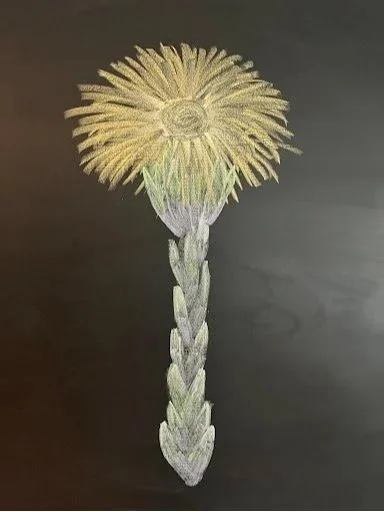
Compassion
Can you travel with me?
My brother, my sister
Can you travel with me?
Through the darkness wide
Bearing with me
Without changing or fixing
Bearing with me
Unsure what we will find
Can I travel with you?
My brother, my sister
Can I travel with you?
Through the cold of the night
We can watch the sun setting
The darkness unfolding
We can shiver together
While holding on tight
Can we open ourselves?
To the whispers of wisdom
Where the space in our hearts
Becomes a star shining bright
And like the sun rising
The truth will approach us
First there was darkness
And then came the light
“First there is darkness and then came the light…” What does this mean? It means we first must face a darkness within ourselves before we can have a healing effect through the activity of carrying others in compassion.
I looked at Christ, how he suffers with humans, and I saw how he traveled inwards with them, to the truth. He traveled to the darkest places of the human being. He visited them where they were in prison, and where they were sick. Truth in this way is related to self-knowledge. And self-knowledge seemed to be the key in being able to be compassionate. Because how can we suffer with another if we have not entered into the place of suffering in ourselves? Here, being able to experience our own darkness, seemed the way to relate in a healthy way to our fellow humans.
Through knowing the truth about yourself, and the connected humbleness that must arise from true self knowledge, you can meet your fellow human beings in that place of suffering, because you have journeyed inward to your own sufferings. You Know that place. Your own flowing wound becomes the medicine. Praying together in the Consecration of the Human Being “ me, your unworthy creature*” becomes the foundation on which we relate to our fellow humans.
Emil Bock describes it as follows:
“ Mercy [ compassion] is where an ego person learns to love as an individual, that is, as an ego person who meets another regardless of emotional or traditional ties. This is the mercy [compassion] of the Samaritan towards the man who fell among thieves. Only an ego personality rooted in its own inwardness can extend true love from ego to ego. Those who have not found themselves are not capable of love. But whoever really finds himself, in so doing also finds the other person”
Emil Bock, Studies in the Gospels; Volume 1, 2010 , page 228
But what effects do our thoughts and feelings have on our fellow human beings? Rudolf Steiner talks about spiritual substance that is built up by relating to something with the truth. By relating to an event with the truth, both the event and the person involved are strengthened. Then we are able to contribute to the evolution of humankind. In the Theosophy of the Rosicrucian, Steiner describes how the way we think and feel about each other can either strengthen our fellow human being or cripple our fellow human being. He explains how our thoughts either contribute or obstruct the evolution of humankind. Thus, we could say that we as human beings are not isolated but instead we are co-creators of each other’s destinies. And this is very exciting, because it means that we can be very meaningful in each other’s lives!
The materialist agrees that injury is caused if he throws a stone at a man, but he thinks that a thought of hatred which he may harbour against a fellow-creature, does not hurt him. Those however who have real knowledge of the world know that far, far stronger effects proceed from a thought filled with hatred than can ever be caused by a stone. Everything that a man thinks and feels has its effects in the outer world and the seer can follow with great precision the effect of a loving thought that goes out to another man, and the very different effect that is produced by a thought filled with hatred. When you send out a loving thought to someone the seer perceives a form of light shaped like a sort of flower-calyx, playing around his etheric and astral bodies, thereby contributing something to his vitality and happiness. On the other hand a thought of hatred bores its way into the etheric and astral bodies like a wounding arrow.”
-Rudolf Steiner, Theosophy of the Rosicrucian, page 60-61
So I find myself again with my daughters in the garden, asking the question: will my thoughts be like an arrow, wounding my fellow human beings? Or will my thoughts be like a flower calyx, supporting and allowing the fragile leaves of the flowers to show its face and to flourish and shine?
*Excerpt from the Offering section of the Consecration of the Human Being
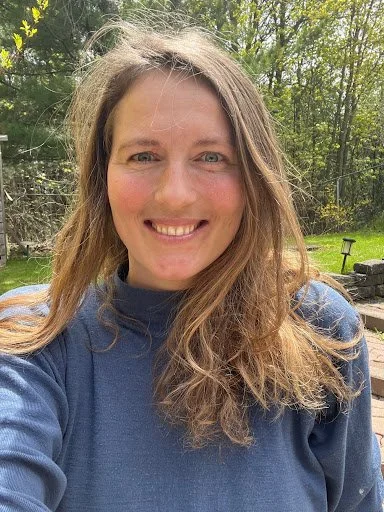
Emma van der Steen-Straver is part time student at Hamburg seminary and Distance Learning Program participant. She loves to be outdoors with her two young children.
- This is a blog entry by The Seminary of the Christian Community in North America. These are posted weekly by the student blog team of Athena Masilungan, Nicole Reinhart, and Lincoln Earle-Centers. For more information about our seminary, see the website: www.christiancommunityseminary.ca and for more video/audio content check out the Seminary’s Patreon page: www.patreon.com/ccseminary/posts.
The views expressed in this blog entry are the views of its author, and do not necessarily represent the views of the Seminary, its directors, or the Christian Community.