

The Water of Life: Money as Healing Force in Community - By Cecilia Valasquez
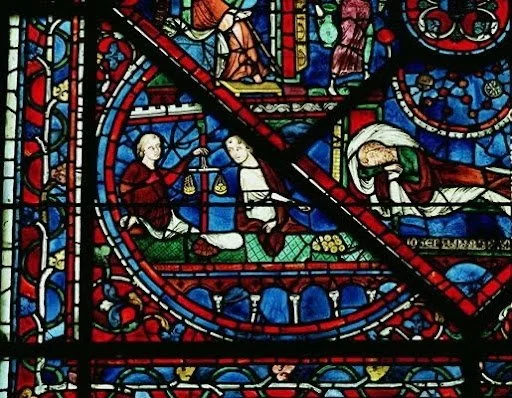
Image: 13th Century Stained Glass
When I was asked to choose a topic for my internship project, I chose money. Not because I am an economist, though I am an accountant by training, but because I believe money is one of the most universal and least spoken about spiritual themes of our time. In families, in communities, in churches, it tends to remain in the shadows, generating anxiety, silence and sometimes conflict. And when it does come into the open in religious contexts, it is not always handled well. There are too many cases where churches and religious institutions have used spiritual influence to pressure or take advantage of people financially, causing real harm and leaving many with a deep mistrust of any conversation that connects faith and money. I wanted to bring this theme into a different kind of light: the light of the Gospel, of anthroposophy, and of the debates that are very much alive in our world today about inequality, the flow of wealth and the future of the global economy. What I found surprised me. The images were already there, waiting to be seen.
In biblical imagery, water symbolizes the vital flow that sustains and gives life. From the beginning, in paradise, God offered all of creation to humanity, represented by Adam and Eve, so that they could sustain themselves and live alongside Him in paradise. God makes only one request: that they not eat from a certain tree. If we reflect on this request, we can understand it as a test that Adam and Eve had to pass. This test was not to punish them, but to prove their trust in God and their capacity to participate in the vital flow of life. This trust would allow them to form a bond with God, not one of total dependence but one of active participation in freedom. Thus, humanity is called to participate in the flow of the water of life that sustains creation. Can money, when understood in its true sense, become water of life?
From the very beginning, a desire has arisen in us that overpowers trust, generating greed and leading us to take what has not been given to us without thinking of others. Adam and Eve could have asked God directly and honestly questioned the commandment. However, the possibility of separating ourselves from the Source was already present as a potentially painful path toward freedom. Perhaps there were other paths, but this was the one we took. The Fall brought about an even greater separation. Human beings incarnate in the material world with the impulse to want everything for themselves. With us, egotism and selfishness also incarnate.
The seed of selfishness brings with it the possibility of sinning, erring, and distancing ourselves from the divine. We separate ourselves from the Tree of Life and the Water of Life, which maintain unity. This selfishness taints our capacity to love. Individuality emerges when we forget to live in community and brotherly love. However, this separation is illusory because the divine does not wish to be separated from us and seeks to reunite us by every means possible. This is why Christ Jesus became human and calls us to live in community and brotherly love so that the water of life may flow upon the earth once more. In the Act of Consecration of the Human Being, after the Gospel reading, we say: “We lift up our soul to you, O Christ.” We do not lift up our separate souls; rather we recognize that we form one soul: the soul of the body of Christ Jesus.
In Deuteronomy 15, we find two statements that seem completely contradictory. The first, in verses 1–6, reads:
“At the end of every seven years you shall grant a release. And this is the manner of the release: every creditor shall release what he has lent to his neighbor. He shall not exact it of his neighbor, his brother, because the Lord’s release has been proclaimed. Of a foreigner you may exact it, but whatever of yours is with your brother your hand shall release. But there will be no poor among you; for the Lord will bless you in the land that the Lord your God is giving you for an inheritance to possess—if only you will strictly obey the voice of the Lord your God, being careful to do all these commandments that I command you today. For the Lord your God will have blessed you, as he promised you, you shall lend to many nations, but you shall not borrow; and you shall rule over many nations, but they shall not rule over you .”*
What do we see here? It's a measure to counteract our tendency toward selfishness and appropriating God's blessings for everyone every seven years. God promises that if we obey his word and follow his commandments, there will be no poor among us. If we recognized that the earth and everything on it—including us and what we can create with our gifts—belongs to God and has been given to us as an inheritance for all humanity, then selfishness would be impossible and that reality would be possible.
However, in the same chapter, verse 11 states that there will always be poor people on Earth. Recognizing that we will never fully live in brotherhood, God asks us to be generous with our brothers and sisters. He asks us to open our hearts and give to those in need. God knows that we will make the mistake to enslave one another and corrects this mistake by asking us not to enslave the poor forever and establishing the sabbatical year of release, setting slaves free every seven years. Slavery is abuse aimed at enriching oneself at the expense of others by treating people as objects rather than as brothers and sisters. This slavery should not be understood solely in reference to that which existed in those times, but also in reference to modern forms of objectifying and abusing people, even if we do not call them slavery. God acknowledges that we will not know how to share the land He gave us, and we will tend to take it for ourselves, depriving others of shelter and sustenance. Therefore, every fifty years, the land must be redistributed to those who have been left without it. These measures aim to rebalance relationships and protect the vulnerable. We were placed on Earth to rule over and care for it as a community, yet we constantly forget this.
The Bible acknowledges our difficulty in living in brotherhood. We might think this is only the case in the Old Testament because Jesus Christ had not yet become incarnate and brought true love—self-sacrificing love—into the world. However, even after becoming incarnate and living among humans, Jesus Christ said in Mark 14:7, “The poor you will always have with you.”
If there will always be poor people on Earth, then we must sadly accept that perfect brotherhood is difficult to attain while we are incarnated in the material world. Freedom and the temptation of selfishness go hand in hand, always putting us at risk of succumbing to greed and a lack of love. However, “what is impossible for us is possible for God” (Luk 18:27).
Christianity provides a remedy for the sickness of sin. First, we must be aware that poverty is not a divine punishment, but rather a consequence of our actions. This is why it is important to follow Christ Jesus’ example. It is not enough to merely regulate the economy through laws; we first of all transform our hearts through understanding so that we may recognize the need for fraternity to sustain the human project. According to Christianity, all of humanity is the body of Christ Jesus, and even the Earth is part of this body, destined to become the New Jerusalem.
According to the Bible, what is poverty? Is it merely material deprivation? While it certainly includes the material aspect since we have physical bodies made of matter, it is not limited to that. The temptation of Christ Jesus in the desert, as recounted in Matthew 4 and Luke 4, offers us an illuminating image: After fasting for 40 days, He felt physical hunger. The tempter said to Him, “If you are the Son of God, turn these stones into bread.” Christ Jesus' response was firm and clear: “Man does not live on bread alone.” Matthew adds: “but on every word that comes from the mouth of God.” Jesus Christ felt physical hunger but not spiritual hunger. The Word of God—spiritual nourishment—sustained Him in the face of this trial. When we focus only on the material, we fail to sustain the human being in their entirety.
Focusing solely on material things creates an insatiable hunger. Gandhi expressed this idea clearly: “There is enough on Earth to satisfy everyone's needs, but not enough to satisfy the greed of some.” However, Christ Jesus taught us an even deeper truth that we find difficult to keep in mind: All of humanity is one. It is united with the Earth and is, in reality, a single body—the body of Christ Jesus.
When we view money as an expression of the value of the spiritual gifts we have been given to serve others, including ourselves, we realize that everything on Earth is a gift. Our body, intelligence, and entire being are gifts that we must care for and nurture. Our creations are never solely our own; they depend on spiritual inspiration, which rains down in abundance. When what we create serves not only ourselves but also others, the true value of money is generated. This way of thinking allows us to understand how harmful it can be to accumulate excess money and the damage it can cause to our souls.
In his lectures on economics and money, Rudolf Steiner proposes that money that is not used to provide a genuine service to others, such as an interest-free loan or a gift, should lose value over time. In my opinion, this is one of Steiner's most valuable insights for transforming our conception of money.
In terms of the water cycle, the loss of money’s value can be likened to evaporation. Excess water naturally evaporates and forms clouds around the Earth. These clouds can then fall back down as rain, sustaining life where it is needed. When we are not aligning with God’s purpose we disturb the healthy flow and create negative effects similar to natural disasters. Natural disasters caused by water occur when there is too much or too little flow. Rivers with excessive flow overflow and destroy, and the same happens with lakes. Conversely, water scarcity creates inhospitable desert areas, which are recognized throughout the Bible as places of trial. In order to overcome the desert's trials, we must awaken our consciousness.
We have another image that helps us understand the necessity of the flow of water more concretely: our own bodies. The water that keeps us alive is our blood. Imagine if the heart held back all the blood; the body would die. Or imagine if blood stopped flowing to our little toe. This small part of our body, which we hardly pay attention to, when deprived of blood has the power to bring death to our entire body.
These images invite us to ask ourselves honestly: how is money flowing through my life and through our community? But the question does not stop there. We can look at the world around us and ask the same thing. In our global economy, money flows with extraordinary speed and volume, and yet it does not flow freely to all. In South America, as in much of the global south, communities and entire nations experience the consequences of a system in which wealth accumulates in few hands while many are left without the basic flow they need to sustain life. This is not accidental. It is the result of an economic culture which treats human beings and the natural world as objects to be used in the service of profit rather than as living parts of one body. When we look honestly at these realities through the image of money as water of life, we cannot help but ask: where is the flow being blocked, and what would it take to free it?
Bringing money into the light of the Gospel and anthroposophy does not make these realities less painful or less complex. But it gives us a different way of seeing them, and perhaps a different way of responding. It moves us away from shame, anxiety and silence toward something more honest, more generous and more alive. That conversation, between faith and money, between the spiritual and the economic, between what is and what could be, is one I believe our communities, our families and our world urgently need to have.
*The Old Testament law does not establish universal brotherhood because it applies only to the people of Israel. It does call for compassion toward foreigners as well, just not in the same way. However, Christ elevates and updates the Law, asking us to include every human being.
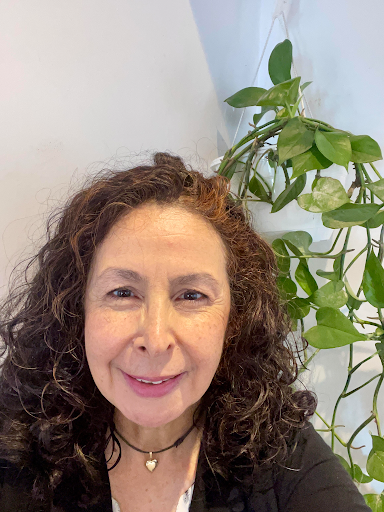
Cecilia Velasquez is a Peruvian living in Lima. She is married and the proud mom of two young daughters, with two playful dogs completing our family. She recently finished her internship in Cali, Colombia and Lima, Peru.
- This is a blog entry by The Seminary of the Christian Community in North America. These are posted weekly by the student blog team of Athena Masilungan, Nicole Reinhart, and Lincoln Earle-Centers. For more information about our seminary, see the website: www.christiancommunityseminary.ca and for more video/audio content check out the Seminary’s Patreon page: www.patreon.com/ccseminary/posts.
The views expressed in this blog entry are the views of its author, and do not necessarily represent the views of the Seminary, its directors, or the Christian Community.