
Entering the Wound as a Loving Deed - By Lisa Ni Conchuir
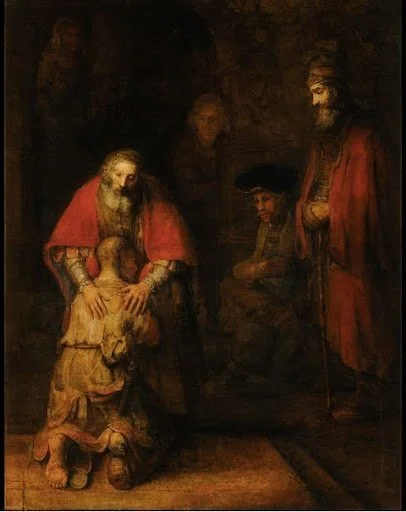
“The Return of the Prodigal Son,” Rembrandt van Rijn
“If anyone would come after me, let him deny himself and take up his cross and follow me.”
Matt 16:24, Mark 8:34
In Shepherding class with Rev. Patrick Kennedy he shared that as we go “towards light, towards Christ Jesus, we are coming through Light and the Darkness is revealed.” Rudolf Steiner also refers to this darkness as our Double, Shadow or Lower Self. Within it we carry our wounds. The emotional wounds we each carry may have originated in childhood, adulthood or even, as the origin of some wounds can seem so mysterious and elusive, have been carried forward from a past incarnation. In our recent “Knowing Christ” year in Toronto we were blessed to receive four sessions on ‘Soul Care’ with Rev. Luis Gonzales*. He shared with us the nature of the wound, how to approach the wound, and how to work with our own wounds through the love and light of Christ. For potential priests it is important to be conversant with one’s own wounds and the journey of deep exploration and healing that Christ invites us into. Then one is able to be with another experiencing their wounds and to help guide the person lovingly and in their own time frame to reach a new view. Rev. Luis shared with us an understanding “that one is not the wound but carries the wound.”
We learned with Rev. Luis through talks, discussions, exploring questions, self-reflections, artistic experiences, sharing and listening. This was a rich and reflective time and I’d like to share with you some aspects of the four steps that we learned in order to work with a wound.
The Pain - We generally experience pain before awareness of the wound. Think of when our skin receives a laceration, a physical pain. It is the pain that brings our attention to the location and nature of what has happened and only then can we address the physical wound. Emotional pain works in the same way. It allows us to see the wound but only if we look for it! Rev. Luis brought the question to us: Can we view pain and the wound as a sickness in our destiny of development? Try to see the pain as a gateway to grace and as a sickness requiring healing.
The Wound - The wound needs our understanding and love. We can close the wound over by pushing the pain away. The wound can then fester and the darkness become more enveloping of our self. In this closing over of the wound we create distance between ourselves and healing AND between ourselves and Christ. We need to get to know the wound, to enter and explore it and bring it as close to us as possible rather than pushing it away or pretending it isn't there. Then we begin to approach the truth behind the wound and to approach Christ.
The Transformation - How do we transform and heal the wound? Can we see pain as the midwife helping a new creation emerge? Can the seemingly destructive energy be transformed into constructive energy? We may choose to participate in a Sacrament of Consultation[1] to help us ‘Learn’[2] about ourselves, a situation, a wound through conversation. In Goethe’s fairytale[3] we hear a question, “What is more precious than light?” and the answer is “Conversation.” In healing from the wound we are praying for Christ’s light to shine into the wound. And, before we come to the light we may reach understanding through conversation. This conversation may be with a priest, with ourselves or in prayer– a conversation with Christ Jesus. Through conversation the light comes!
The Renunciation of Power - Here we may open through prayer, through humility, through acceptance and honestly looking at ourselves, that we may receive grace and the forces of resurrection. This is where we strive to see the wound as a gift, and if we cannot yet understand this, to strive to accept it as being the will of God. It is then through the activity of humbly asking through prayer, through this conversation with the divine for help and acceptance that we may enter a place of powerlessness. If one cannot understand the reason for the pain then perhaps we may ask for patient endurance through this process, and for the light of Christ to shine through the wound in our soul’s thinking, feeling and willing. If we attend the Consecration of the Human Being then we may also bring awareness of our wound to the altar for healing. We receive the healing medicine at the service as we take in the body, blood and peace of Christ, which offers to us the potential every time for transformation of our hearts and minds, the offering of love from Him. Through the act of powerlessness and of true, earnest, seeking, the divine power of the spiritual world and of Christ Jesus may enter our life. Then transformation is possible of what can seem impossible.
Another aspect that I have found when working with a wound is to approach it as moral work in the world. An aspect of this moral work is to love whatever it is that we are doing, to take genuine interest in it. “When we extend our interests, when we find opportunity to meet the objects and beings of the world with understanding, forces are called forth within us …” Rudolf Steiner, The Spiritual Foundation of Morality, Lecture 3. Norrköping, May 30 1912. Recently I have been working with a wound and when I turned my heart and mind to really strive to understand it in light of God’s will, to meet it with the interest that Rudolf Steiner speaks of above, I began to receive light in my thinking[4]. This new enlightened thinking “called forth forces from within” enabling me then to enter more deeply into the activity of the wound with gratitude. I received a deep understanding and acceptance of something that had been deeply painful. I could see the perfection of everything that Christ Jesus, who bears and orders the life of the world, had provided for me to learn from in the form of everyday life. This has enabled me to experience my wound, to learn and to develop. I imagine that this wound will rise again but I am now changed and strengthened in my knowing and trusting that by entering the wound through the above process I may, without expectation, meet Christ and be healed and truly permeated with his love, grace and truth. It was only through approaching my wound from a truthful place, often the most difficult part of the work, that I could observe myself in truth and take responsibility for my contribution. Christ Jesus does invite us to be with him and shares with us how, “If anyone would come after me, let him deny himself and take up his cross and follow me.” (Matt 16:24, Mark 8:34)
I had initially thought that taking up one’s cross was making a decision to follow Christ, but through conversation with Rev. Jonah Evans I learned that one way of taking up one’s cross is to enter the wound. As Christ Jesus willingly walked to the Cross, to be wounded, to take on the wounds of the world that he may be with us, he was held in love by the Father. As we take up our cross and enter our wounds, Christ Jesus will be with us if we seek him and he will hold us in his love. Christ took up the sins of all of humanity on the hill of Golgotha. He took up the wound of humanity that came upon us at the Fall in the Garden of Eden. Christ shone his own light, his light which is love into the world. He offered it into the wound of the world as the most loving deed that has ever existed on the earth. As we enter the wound in the light of Christ we are also undertaking moral work as a loving deed in the world and become ever closer to our Lord, Christ Jesus.
May we offer ourselves to the world through love. May our deeds be imbued with love. May our entering the wound be also a deed of love, a deed that fulfills the new commandment given by Christ Jesus at the last supper “that you love one another: just as I have loved you, you also are to love one another” (John 13:34). Thus may we too work with love for ourselves, for others, with Christ and with the wound that can lead us to encounter and experience Christ’s resurrection forces within us all.
*Reverend Luis Gonzales is a congregational priest in Lima, Peru and also works as Lenker for the region of South America.
[1]The Sacrament of Consultation is a sacrament of The Christian Community. It is a renewed sacrament of the Confession. It involves a conversation with a Priest to explore anything that one may wish to discuss or to bring light to and concludes with a Blessing Prayer and the receiving of Communion.
[2]‘Learn’ is a key word spoken in the Blessing Prayer one receives during the Sacrament of Consultation.
[3] Johann Wolfgang von Goethe, The Fairytale of the Green Snake and the Beautiful Lily
[4]Words that we hear in the Consecration of the Human Being.
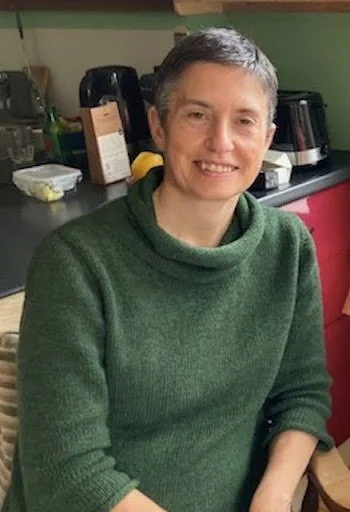
Lisa Ni Conchuir, 53, is a “Knowing Christ” student. She lives with her husband in the beautiful Yarra Valley, just outside Melbourne in Australia. Alongside the joys of Seminary study and The Christian Community, Lisa enjoys gardening -particularly berries, growing plants and produce for market sale, hosting Biodynamic workshops, walking in nature and in spare moments some relaxation with calligraphy or wood carving.
- This is a blog entry by The Seminary of the Christian Community in North America. These are posted weekly by the student blog team of Athena Masilungan, Nicole Reinhart, and Lincoln Earle-Centers. For more information about our seminary, see the website: www.christiancommunityseminary.ca and for more video/audio content check out the Seminary’s Patreon page: www.patreon.com/ccseminary/posts.
The views expressed in this blog entry are the views of its author, and do not necessarily represent the views of the Seminary, its directors, or the Christian Community.